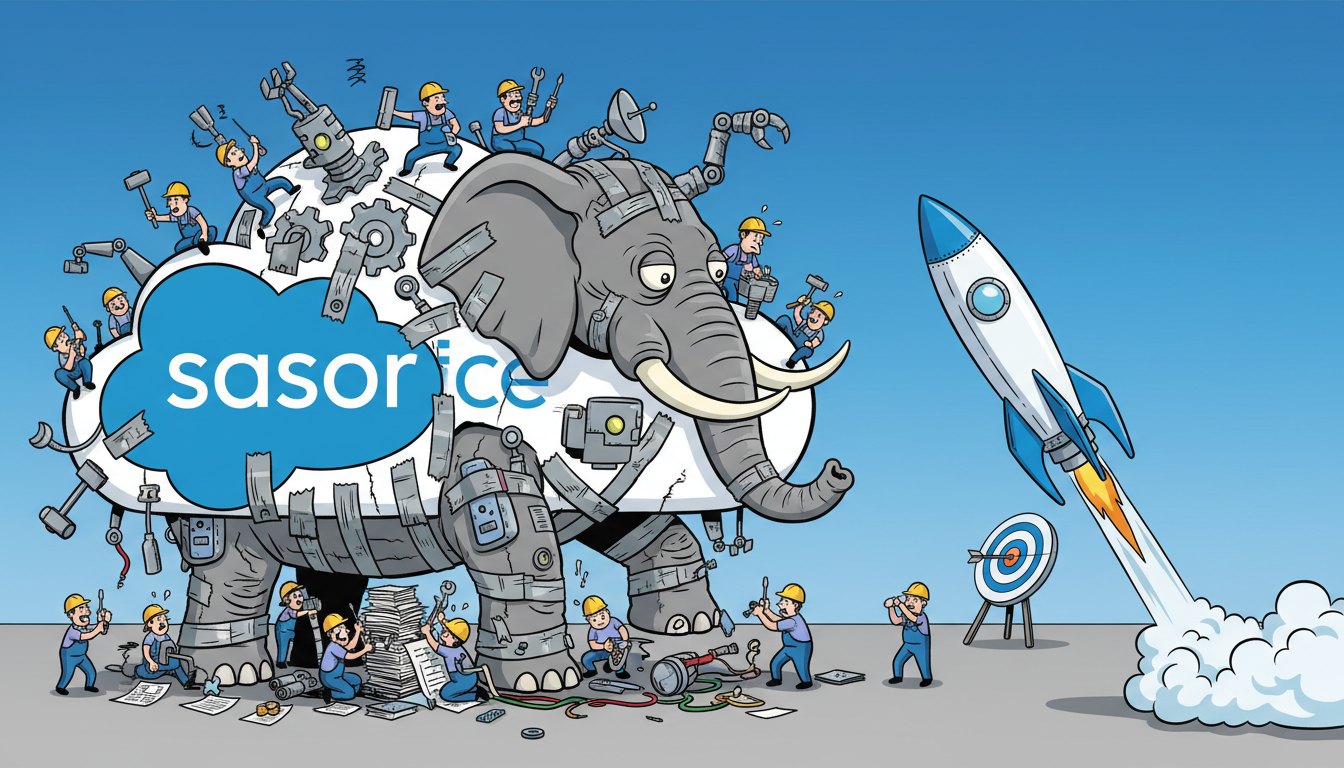
Salesforce (ticker: CRM) stock has declined approximately 15-20% from its 2024 peak, driven by three primary factors: revenue growth deceleration from 11% to single digits, operating margin compression as AI development costs rise, and investor concerns about competitive threats from AI-native platforms that challenge Salesforce’s legacy architecture and pricing model.
What specific factors are causing CRM stock to underperform?
Salesforce faces a confluence of structural headwinds. Revenue growth has slowed from double-digit rates to high single digits as enterprise customers delay purchasing decisions and scrutinize software spending. The company’s operating margin has compressed as it invests billions in AI infrastructure, including the Einstein GPT and Agentforce platforms, while simultaneously maintaining legacy codebases.
The market is repricing Salesforce based on its maturity curve. When a software company transitions from growth to value, multiples contract. CRM stock historically traded at 8-10x forward revenue; it now hovers closer to 5-6x as investors question whether AI investments will generate proportional returns.
Competitive pressure has intensified. AI-native CRM platforms built on modern architecture can offer similar functionality at lower price points without the technical debt of a 25-year-old codebase. Salesforce’s response – layering AI features onto existing products – creates integration complexity that some customers find prohibitive.
Customer acquisition costs have risen while net retention rates have declined. Enterprises are consolidating vendors and demanding proof of ROI before renewing contracts. Salesforce’s land-and-expand model, which relied on upselling additional clouds, faces resistance as buyers question whether they need separate products for sales, service, marketing, and commerce when integrated platforms exist.
Salesforce’s customer acquisition cost increased 23% year-over-year while net dollar retention fell below 110% for the first time since 2016.
The decline signals a broader market shift away from platforms that require extensive customization and ongoing administration costs that exceed license fees.
How does Salesforce’s AI strategy affect its stock performance?
Salesforce has committed over $4 billion to AI development, but the monetization path remains unclear. Einstein GPT launched with significant fanfare, yet adoption has been slower than projected. Enterprises hesitate to pay premium prices for AI features when they can access comparable capabilities through API calls to foundation models at a fraction of the cost.
The Agentforce platform, announced as Salesforce’s answer to autonomous AI agents, competes directly with solutions from Microsoft, Google, and dozens of startups. Investors question whether Salesforce can maintain pricing power when customers can build similar agent workflows using open-source frameworks and commodity compute.
AI development costs hit operating margins immediately while revenue benefits materialize slowly. This creates a J-curve effect where profitability dips before recovering. Wall Street punishes companies in the trough of that curve, especially when competitors demonstrate faster time-to-value.
Salesforce’s AI strategy also highlights architectural limitations. Adding AI to a monolithic platform requires extensive refactoring. Newer platforms built with microservices and API-first design can integrate AI capabilities more seamlessly, creating better user experiences with less engineering overhead.
The market rewards companies that demonstrate clear AI ROI with measurable productivity gains and cost savings; it penalizes those offering AI as a checkbox feature.
Why are investors concerned about Salesforce’s competitive position?
Salesforce’s dominance in CRM is eroding at the margins. Microsoft Dynamics 365 has gained share by bundling CRM with Office 365 and Teams, creating a unified workspace that reduces context switching. HubSpot has captured the SMB and mid-market with simpler onboarding and transparent pricing. Vertical-specific CRMs have taken share in healthcare, financial services, and manufacturing by offering pre-built compliance and workflow templates.
The company’s pricing model faces pressure. Salesforce charges per user per month with feature tiers that force customers to buy enterprise editions for capabilities that should be standard. Competitors offer usage-based pricing or flat-rate team plans that align better with how modern businesses consume software.
Enterprise customers increasingly view Salesforce as a legacy investment requiring significant customization and ongoing administration. The total cost of ownership – including Salesforce admins, consultants, and integration specialists – can exceed the license fees. Buyers question whether that complexity is justified when alternatives offer 80% of the functionality at 40% of the cost.
Salesforce’s partner ecosystem, once a moat, has become a liability. Customers complain about being locked into expensive implementation partners and annual maintenance contracts. The AppExchange, while extensive, creates integration fragility as third-party apps break with platform updates.
These dynamics are structural rather than cyclical, which explains the sustained stock pressure.
What does CRM stock performance mean for businesses evaluating CRM platforms?
Salesforce’s stock struggles signal a broader market shift toward platforms that deliver immediate value without requiring armies of consultants. Businesses, especially in the MSP sector serving clients across medical, legal, and manufacturing verticals, need CRM systems that integrate with existing tools and provide ROI within weeks, not quarters.
The decline in CRM stock reflects enterprise fatigue with platforms that promise comprehensive solutions but deliver complexity. MSPs in Salt Lake City face a specific challenge: they need CRM systems that integrate with ConnectWise and Autotask PSA platforms, document every client commitment with call recording and transcription, and surface insights without manual data entry.
Traditional enterprise CRM platforms were built for companies with dedicated sales operations teams. An MSP running $2-3 million in annual recurring revenue with technical staff who also sell cannot afford the overhead of Salesforce administration. They need systems that work immediately and require minimal configuration.
Utah’s one-party consent law for call recording creates an operational advantage for MSPs who adopt CRM platforms with native recording and transcription. When a client disputes what was promised during onboarding, having word-for-word transcripts settles the issue immediately. Salesforce requires third-party integrations for this functionality, adding cost and complexity.
The market is rewarding platforms purpose-built for specific workflows over general-purpose systems requiring extensive customization. For MSPs, this means CRM platforms designed around the sales-to-delivery lifecycle with IT audit modules, technical discovery templates, and PSA synchronization.
MSP-specific CRM platforms that integrate with existing PSA tools eliminate double data entry and provide context when technical staff switch between support tickets and sales conversations. AI features built specifically for MSP workflows – like flagging upsell opportunities when clients mention office expansions or new hires – deliver measurable ROI that generic AI assistants cannot match.
What should MSPs prioritize when choosing CRM platforms?
MSPs need CRM platforms that solve three specific problems: accountability for client commitments, sales training for technical staff, and upsell opportunity capture. Call recording with full transcription addresses the first problem by creating an immutable record of every promise made during sales calls and QBRs.
Sales training becomes scalable when new hires can listen to successful calls and see exactly how experienced reps handle objections about price and scope. Technical staff who also sell need coaching that understands the difference between a support call and a sales conversation, providing relevant prompts without creating noise.
Upsell opportunity capture requires AI that parses conversations for signals like office expansions, new locations, or hiring surges. When a client mentions opening a second office, the system should flag that for follow-up with a network expansion proposal. Manual CRM systems miss these opportunities because humans forget or don’t recognize the signal.
Integration with ConnectWise Manage and Autotask is non-negotiable. MSPs already have client data, ticket history, and billing information in their PSA. A CRM that doesn’t sync bidirectionally creates duplicate data entry that technical staff will refuse to do.
Compliance matters for MSPs serving healthcare and legal clients. The CRM must handle call recording in accordance with Utah’s one-party consent law and provide audit trails for client conversations. HIPAA compliance requirements mean the platform must document how client data is stored, encrypted, and accessed.
The IT audit module is critical for assessment-led selling. MSPs win deals by conducting technical assessments that score client estates and identify gaps. A CRM with built-in audit workflows, scoring rubrics, and presentation builders allows MSPs to generate professional proposals on-site, shortening sales cycles.
Key features MSPs should evaluate include:
- Native call recording and transcription with searchable archives
- Bidirectional sync with ConnectWise Manage and Autotask PSA
- AI-powered upsell opportunity detection from conversation analysis
- Built-in IT audit module with scoring and proposal generation
- HIPAA-compliant data handling and encryption
- Sales coaching that distinguishes support calls from sales conversations
- One-hour learning curve for technical staff adoption
MADDOX CRM was built specifically for this workflow. It records every call and meeting word-for-word, integrates natively with ConnectWise and Autotask, and includes an IT Audit module for assessment-led selling. The Ask Maddox feature answers questions about client history by searching transcripts and CRM data, eliminating the knowledge loss when technical staff leave.
For MSPs in Salt Lake City navigating competitive pressure and margin constraints, the choice is between generic enterprise platforms requiring customization and purpose-built tools that solve MSP-specific problems immediately.
Frequently asked questions
Will CRM stock bounce back?
CRM stock recovery depends on Salesforce demonstrating that AI investments generate proportional revenue growth and that competitive threats are contained. Analysts project modest recovery if the company stabilizes net retention rates and proves its AI monetization strategy. However, structural headwinds from AI-native competitors and pricing pressure may limit upside to 10-15% over the next 12-18 months.
Is it time to sell CRM stock?
Selling CRM stock depends on investment thesis and time horizon. Long-term holders betting on Salesforce’s installed base and ecosystem may hold through volatility. Momentum investors concerned about continued margin compression and competitive losses may reduce positions. The stock trades near five-year valuation lows, suggesting much negative sentiment is priced in, but catalyst for re-rating remains unclear.
Why did Salesforce CRM stock drop so much?
Salesforce stock dropped due to decelerating revenue growth, operating margin compression from AI investments, and rising competitive threats from Microsoft, HubSpot, and AI-native platforms. Customer acquisition costs rose 23% while net dollar retention fell below 110%, signaling challenges in both new customer acquisition and existing customer expansion. Market repriced the stock from growth to value multiple.
Is CRM a good long term buy?
CRM as a long-term investment depends on belief in Salesforce’s ability to defend market share and monetize AI successfully. The company has durable enterprise relationships and switching costs, but faces architectural disadvantages versus modern platforms. Conservative investors may wait for proof of AI ROI and margin stabilization. Valuation at 5-6x forward revenue offers some downside protection if fundamentals stabilize.
What will CRM stock be worth in 2030?
CRM stock value in 2030 depends on revenue growth trajectory and multiple expansion or contraction. If Salesforce maintains 8-10% annual growth and re-rates to 7x revenue, stock could reach valuations 40-60% above current levels. If competitive pressure accelerates and growth slows to mid-single digits, stock may trade sideways or down. AI monetization success is the primary variable determining outcome.
Does Salesforce have a future?
Salesforce has a future as a major enterprise software vendor with durable customer relationships and significant installed base. However, its dominance is challenged by AI-native competitors, pricing pressure, and architectural limitations. The company must successfully integrate AI, defend market share, and prove that legacy platform advantages outweigh modern architecture benefits. Future likely involves slower growth and margin pressure.