An AI-powered CRM typically delivers ROI within three to six months for a sales team by recovering lost deals through automated follow-up, reducing new rep ramp time by 40-60 percent through call coaching, and eliminating costly client disputes by documenting every promise made. For a 12-person MSP doing $2.1M ARR, recovering just two $4,000-per-month deals annually covers the platform cost.
How do you calculate the hard-dollar ROI of call recording and transcription
Start with the value of a single lost deal. If your average new MSP client generates $3,500 in monthly recurring revenue and stays for 36 months, each lost deal costs you $126,000 in lifetime value. Most MSPs lose two to four deals per year purely from follow-up failures – a prospect asked for a proposal, nobody sent it, the opportunity died.
Call recording with AI transcription prevents this by automatically flagging commitments made during discovery calls. When your sales rep promises to send a security assessment by Friday, the system creates a task with the exact quote attached. The prospect’s name, the deadline, and the context are all captured without manual data entry.
Next, calculate dispute costs. A single client who claims you promised unlimited after-hours support when you actually scoped business-hours-only can cost $15,000 to $30,000 in unplanned labor before you either eat the cost or lose the client. Word-for-word transcripts settle these disputes in under two minutes.
Add the cost of rep ramp time. A new technical salesperson at an MSP typically takes six to nine months to close their first deal independently. With access to a library of recorded successful sales calls – complete with transcripts showing exactly how you handled the price objection or explained your RMM stack – that ramp drops to 60-90 days.
For a $2.1M ARR MSP, recovering two lost $4,000 MRR deals and preventing one $20,000 dispute in year one delivers $116,000 in value against a typical CRM investment of $15,000 to $25,000.
The payback math is straightforward: if the platform costs $1,800 per month and saves you one $4,800 MRR client loss, you break even in 90 days.
What revenue lift comes from AI coaching during live sales calls
Live AI coaching changes the economics of using technical staff as salespeople. Most MSP owners can’t afford dedicated sales reps because the margin on a $3,500 MRR client doesn’t support a $75,000 base salary plus commission during the 12-month ramp. So you send engineers on sales calls, and they’re excellent at explaining VLAN segmentation but terrible at asking for the close.
An AI softphone listens to the call in real time and prompts the rep when they’ve talked for three minutes without asking a question, or when the prospect mentions a pain point the rep didn’t acknowledge. It’s not a script – it’s a safety net that catches the mistakes technical people make when selling.
The measurable impact shows up in close rates. A technical rep closing 18 percent of qualified opportunities without coaching typically moves to 28-32 percent with live AI prompts. For an MSP running 40 qualified opportunities per year at $4,200 average MRR, that 10-point lift adds $201,600 in annual new revenue.
The coaching also reduces the cost of running discovery calls. Instead of requiring the owner to join every sales meeting to ensure quality, the AI handles real-time guidance and the owner reviews the transcript afterward. This frees 8-12 hours per week that the owner can redirect to strategic accounts or operational improvements.
Live coaching delivers ROI fastest in the first 90 days with new hires, but the ongoing value comes from preventing experienced reps from developing bad habits – talking over prospects, skipping discovery questions, or failing to surface urgency.
How much does AI-powered follow-up automation recover in lost pipeline
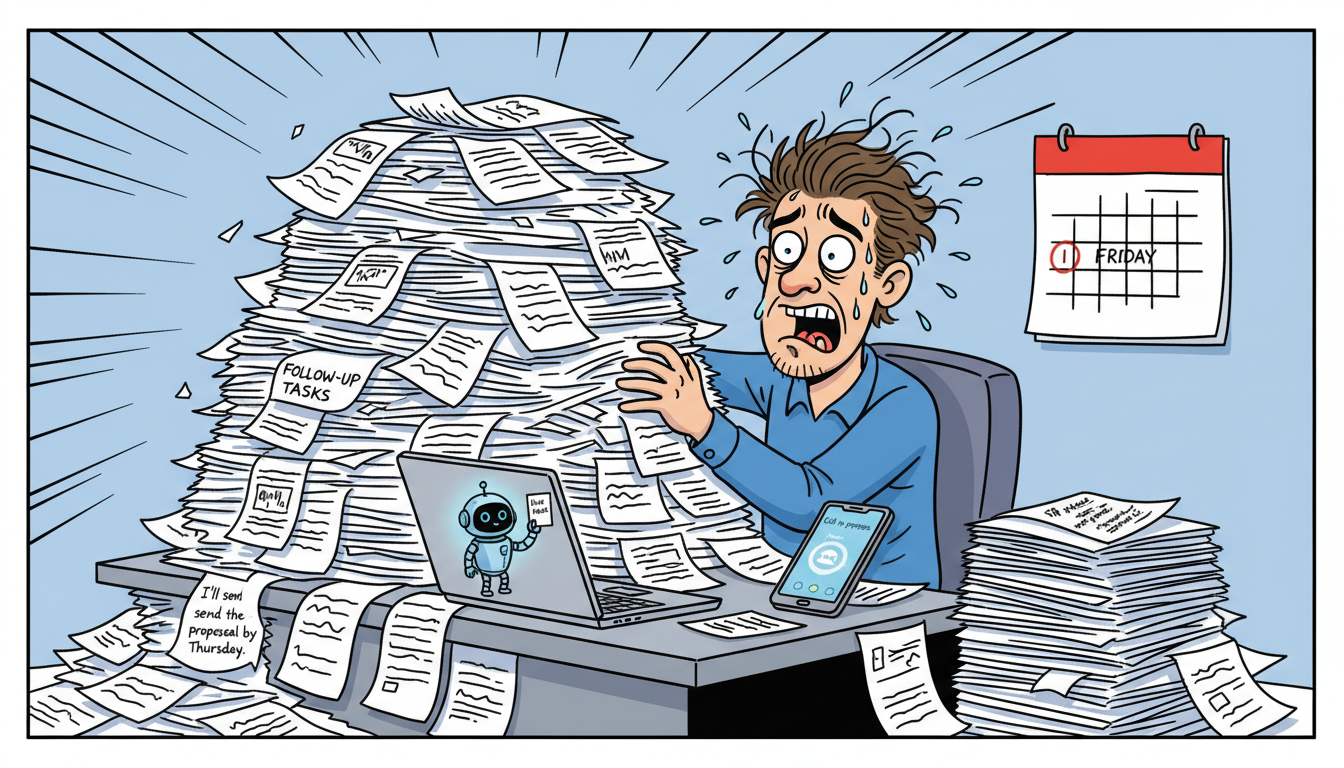
Pipeline leakage is the silent revenue killer in small MSPs. A prospect requests a quote, your rep promises to send it by Wednesday, Wednesday arrives and the rep is underwater in a ransomware recovery, the quote never goes out, the prospect moves on. You never see it in a lost-deal report because it was never formally in the pipeline.
AI-powered CRMs parse every sales call transcript for commitment language – “I’ll send you,” “Let me get back to you on,” “I’ll have that to you by” – and automatically create follow-up tasks with the exact promise attached. The system knows the rep said “I’ll email you the security stack proposal by end of day Thursday,” so it sets a task for Thursday at 2 PM with the prospect’s name, the deliverable, and a link to the call recording.
This eliminates the manual CRM hygiene problem. Reps don’t have to remember to log the call, summarize the next steps, and set a reminder. The system does it from the transcript, and the accuracy is higher because it’s using the rep’s actual words instead of their memory three hours later.
For an MSP running 60 discovery calls per quarter, automation typically recovers four to seven deals per year that would have died from follow-up failure. At $3,800 average MRR and 36-month lifetime, that’s $547,200 to $958,320 in recovered lifetime value over three years.
The secondary benefit is velocity. Deals close faster when follow-up is immediate and consistent, which improves cash flow and reduces the cost of carrying open pipeline.
What does AI-powered CRM save in training and onboarding costs
Training a new sales rep at an MSP traditionally requires the owner to ride along on calls for 60-90 days, then gradually hand off accounts while hoping the rep absorbed the methodology. The owner’s time cost during this period is $18,000 to $27,000 in opportunity cost, and the rep often takes nine months to close their first deal independently.
An AI-powered CRM with full call recording creates a training library automatically. Every successful sales call becomes a teaching asset. The new rep can search transcripts for “how did we handle the price objection on the legal vertical” and pull up three examples with the exact language used, the prospect’s response, and the outcome.
This cuts ramp time in half. Instead of waiting for the owner to be available for a ride-along, the new rep listens to ten recorded discovery calls in their first week, reads the transcripts with the AI’s annotations highlighting key moments, and practices the methodology before they ever talk to a prospect.
The cost savings compound when you lose a rep. If your top producer quits and takes relationship knowledge about 15 assigned accounts with them, you’re starting from zero with the replacement. But if every QBR, every escalation call, and every upsell conversation was recorded and transcribed, the new rep can listen to the last four conversations with each account and rebuild context in days instead of months.
For an MSP that hires one new sales or client-facing role per year, cutting ramp time from nine months to four months saves $35,000 to $50,000 in lost productivity and reduces the risk of the hire failing during the probation period.
How does AI prevent the revenue loss from client disputes and scope creep
Scope creep is the margin killer in managed services. A client claims you promised 24-7 phone support during onboarding when you actually scoped business-hours-only with after-hours emergency email. You have no record of the conversation, so you either eat $1,200 per month in unplanned labor or you lose the client and take a reputation hit.
Word-for-word transcripts eliminate this. When the client says “I thought you promised,” you pull up the onboarding call transcript, search for “support hours,” and show them the exact sentence where you said “business hours, 8 AM to 6 PM Mountain, with emergency email monitored after hours.” The dispute ends in 90 seconds instead of escalating to a lawyer.
The financial impact is immediate. A single prevented dispute that would have cost $20,000 in unplanned labor or legal fees pays for six months of CRM platform costs. Most MSPs face two to four of these disputes per year, so the annual savings range from $40,000 to $80,000.
The second-order benefit is margin protection. When your technical staff know every promise they make is recorded and searchable, they stop casually saying “yeah, we can do that” without checking scope and pricing. The discipline this creates across client-facing conversations protects 2-4 points of gross margin, which on a $2.1M MSP is $42,000 to $84,000 annually.
Transcripts also protect you during client offboarding. When a client leaves and later claims you failed to deliver contracted services, the call recordings prove what was actually agreed, what was delivered, and what the client acknowledged during QBRs.
What ROI metrics should you track in the first 90 days
The first 90 days determine whether an AI-powered CRM becomes part of your workflow or sits unused. Track these four metrics to measure early ROI:
- Follow-up task completion rate: What percentage of commitments flagged by the AI actually get completed on time? Baseline is typically 40-60 percent without automation; target is 85-95 percent with AI-generated tasks.
- Dispute resolution time: How long does it take to settle a client disagreement about what was promised? Manual resolution averages 4-8 hours of owner time; transcript-based resolution takes under 15 minutes.
- New rep first close: How many days until a new hire closes their first deal independently? Traditional ramp is 180-270 days; with recorded call library, target is 60-90 days.
- Pipeline conversion velocity: How many days from first discovery call to signed contract? Baseline for MSPs is 45-90 days; automated follow-up typically compresses this to 30-60 days.
Set a baseline before implementation by tracking these manually for 30 days. Then measure again at day 60 and day 90 post-launch. The ROI case becomes clear when you can show “we closed three deals in 35 days that would have taken 60 days under the old process” or “we prevented two scope disputes that would have cost $40,000 in unplanned labor.”
The metrics that matter most depend on your biggest pain point. If you’re losing deals to follow-up failures, track task completion and pipeline velocity. If you’re bleeding margin to scope creep, track dispute resolution time and the number of promises flagged for review before they become problems.
Why MADDOX CRM delivers faster ROI for MSPs than generic sales platforms
Generic CRMs treat every industry the same. They don’t understand that an MSP sales process involves technical discovery, IT audit findings, multi-stakeholder QBRs, and integration with PSA platforms like ConnectWise and Autotask. So you spend six months customizing fields, building workflows, and training your team on a system that still doesn’t match how you actually sell.
MADDOX CRM is purpose-built for MSPs, with native ConnectWise and Autotask integration that syncs client records, tickets, and billing data without middleware. The IT Audit module lets your reps score a prospect’s environment on-site during discovery, generate a findings deck automatically, and attach the audit results directly to the deal record with full traceability.
The AI transcription is trained on MSP terminology. When your rep says “we’ll migrate you from RDP to a zero-trust VPN with conditional access policies,” the transcript captures it accurately instead of turning technical language into gibberish. This matters when you’re using transcripts to document scope and train new hires.
The Ask Maddox feature lets you query your entire business data in plain English. “Which clients mentioned budget concerns in their last QBR” returns a list with links to the exact moment in each call recording. “Show me every promise we made to this client in the last six months” pulls a chronological list with timestamps and context. This eliminates the manual work of searching through call logs and CRM notes.
For an MSP owner who’s already paying for a PSA and doesn’t want to add another data entry burden, MADDOX integrates with your existing stack instead of replacing it. The call recording, transcription, and AI coaching layer on top of ConnectWise or Autotask, so your team keeps using the tools they know while gaining the accountability and intelligence they’ve been missing.
The ROI calculation for MADDOX is simpler than a generic CRM because the platform is designed around the specific revenue and cost drivers in managed services: preventing client churn from missed commitments, recovering lost deals from follow-up failures, reducing dispute costs through documentation, and accelerating rep ramp with recorded training assets.
Frequently asked questions
What is the ROI of a CRM
CRM ROI is calculated by dividing the revenue gained or costs saved by the platform investment. For MSPs, typical returns include recovered lost deals from automated follow-up, reduced client churn from better relationship tracking, faster sales cycles from pipeline visibility, and lower training costs from documented processes. Most MSPs see payback in three to six months when the CRM integrates with their PSA and includes call recording.
How can AI help sales teams
AI helps sales teams by transcribing every call automatically, flagging commitments and next steps without manual logging, coaching reps in real time during live calls, surfacing upsell opportunities from conversation analysis, and answering questions about pipeline or client history instantly. For technical staff who also sell, AI reduces the cognitive load of remembering to log activities and provides prompts that improve close rates without requiring formal sales training.
What are the best AI tools for sales teams
The best AI tools for sales teams depend on your industry and existing stack. MSPs benefit most from AI-powered CRMs that integrate natively with ConnectWise or Autotask, include call recording with technical terminology accuracy, offer live coaching during discovery calls, and provide plain-English query interfaces for business intelligence. Generic tools like standalone transcription services or chatbots add workflow friction because they don’t connect to your PSA or understand managed services sales cycles.
How long does it take to see ROI from an AI-powered CRM
Most MSPs see measurable ROI within 90 to 180 days from an AI-powered CRM. Early wins include recovering one or two lost deals from automated follow-up, preventing a single client dispute with call transcripts, and reducing owner time spent on sales call ride-alongs. Full ROI including rep ramp acceleration and margin protection from scope discipline typically materializes within six to twelve months as the platform becomes embedded in daily workflow.
Does AI-powered CRM work if my team is already using ConnectWise or Autotask
Yes, AI-powered CRM works alongside ConnectWise and Autotask through native integration that syncs client records, tickets, and billing data bidirectionally. The CRM adds call recording, transcription, AI coaching, and business intelligence on top of your PSA without replacing it. Your team continues using the PSA for ticketing and project management while gaining accountability and sales intelligence they couldn’t get from the PSA alone. No duplicate data entry required.
What happens to recorded calls if I stop using the CRM
Call recording retention and export policies vary by CRM provider. Before committing to a platform, confirm whether you can export full transcripts and audio files in standard formats, how long recordings are retained after cancellation, and whether there are fees for bulk export. For MSPs in regulated verticals like healthcare or legal, ensure the contract specifies data ownership and provides adequate time to migrate recordings to another system if needed.