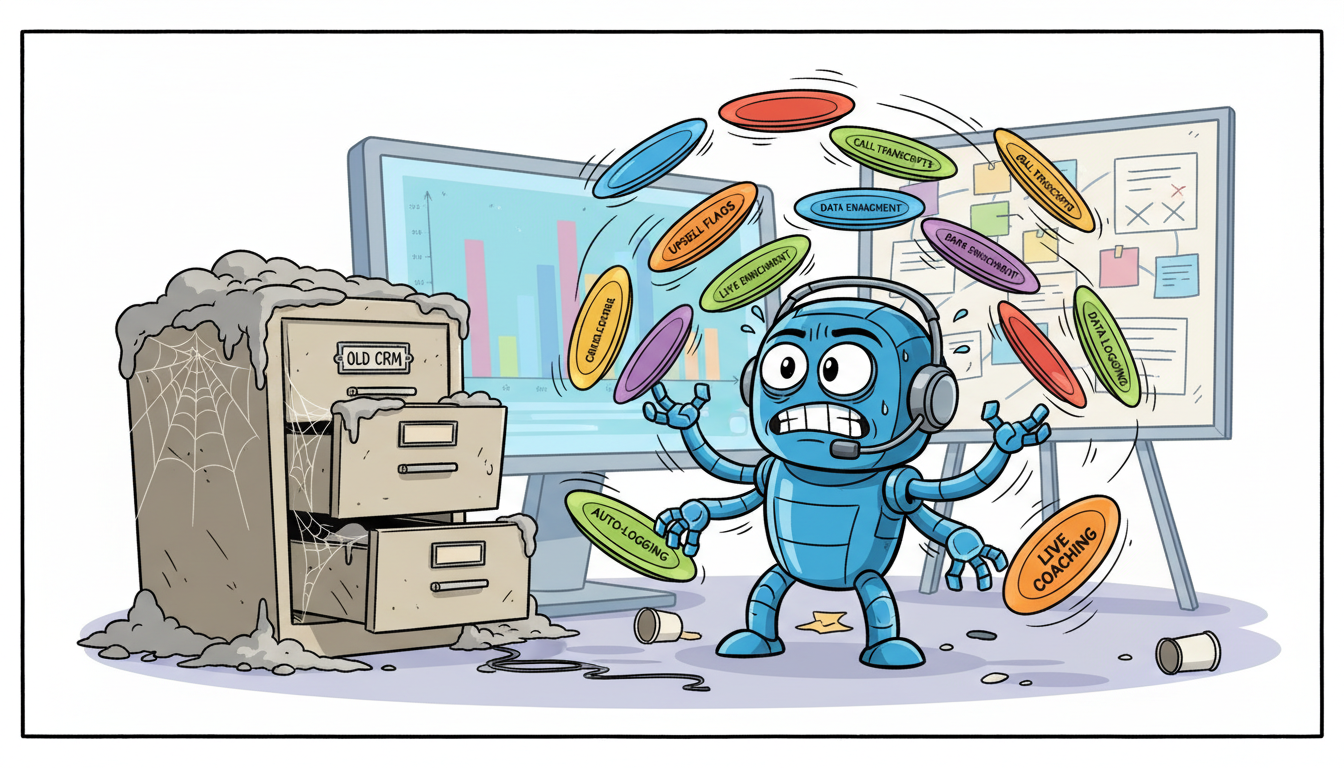
CRM is not being replaced by AI – it is being fundamentally transformed from a passive database into an active accountability system. By 2026, AI-powered CRMs record every client conversation word for word, flag upsell opportunities in real time, and coach sales reps during live calls. The shift is from manual data entry to automatic capture, with 58 distinct AI features now handling tasks that previously required human interpretation and follow-up.
What Does AI Actually Do Inside a Modern CRM
AI transforms CRM from a system of record into a system of intelligence. Traditional CRMs store what you manually enter; AI-powered CRMs capture everything automatically and make it searchable.
Call recording with full transcription means every client conversation becomes a searchable, quotable record. When a client claims you promised something you didn’t, you pull up the exact transcript and timestamp. When a technical team member leaves, their relationship knowledge stays in the system.
Live coaching changes how sales conversations happen. The AI listens to the call in real time, detects when a prospect raises a pricing objection, and surfaces the exact response that closed similar deals in the past. Five call behavior detectors run in locked order, flagging moments that require follow-up before the call ends.
Automatic data enrichment eliminates manual entry. When a caller ID appears, the system returns 15 context blocks – previous conversations, open tickets, contract renewal dates, and flagged concerns – before you answer the phone.
AI features in MADDOX CRM include instant answers from business data, where you ask “Which clients mentioned budget concerns in their last QBR?” and get a list with timestamps and exact quotes within seconds.
The technology doesn’t replace the CRM – it makes the CRM capable of tasks that were previously impossible at scale.
Will AI Eliminate the Need for Sales Reps and Account Managers
AI does not eliminate sales roles; it changes what those roles spend time doing. The shift is from data entry and information retrieval to relationship building and strategic decision-making.
Sales reps in AI-powered systems spend less time logging calls, searching for client history, and trying to remember what was discussed three months ago. The CRM captures all of that automatically. They spend more time on the parts of selling that require human judgment – reading a client’s tone, adapting a pitch mid-conversation, and building trust over years.
Account managers gain leverage. Instead of manually reviewing dozens of client accounts to find who mentioned expansion plans, they ask the AI and get a prioritized list in seconds. Instead of guessing which upsell to propose, they see exactly what the client said they needed, quoted verbatim from the last meeting.
For MSPs, this matters because technical people who also sell can now do both effectively. The AI handles the CRM hygiene – logging activities, updating deal stages, setting follow-up reminders – so the technician can focus on solving the client’s problem and recognizing when that problem represents a sales opportunity.
Training new hires accelerates. Instead of shadowing calls for weeks, a new rep listens to a library of recorded sales calls, filtered by objection type or vertical, and hears exactly how senior reps handle pricing pushback or scope questions.
The role evolves from information manager to relationship strategist, with AI handling the mechanical work that previously consumed most of the day.
How Does AI-Powered CRM Handle MSP-Specific Workflows
MSPs operate in a unique environment where sales, support, and project delivery overlap constantly. AI-powered CRM built for this vertical integrates directly with PSA platforms and understands the difference between a sales call and a support ticket.
ConnectWise and Autotask integration means the CRM syncs bidirectionally with existing PSA tools. When a support ticket escalates into a project opportunity, the conversation history, technical notes, and client approvals flow into the deal pipeline without manual re-entry. Tenant isolation enforces data separation across 11 distinct API scopes, ensuring client data never crosses boundaries.
The IT Audit module allows MSPs to score client estates on-site, build assessment decks automatically, and document findings with timestamps and voice recordings. When a prospect questions a recommendation six weeks later, you play back the exact moment they described their backup failures during the audit walkthrough.
Call recording in Utah operates under one-party consent law (Utah Code § 77-23a-4), giving MSPs operational flexibility. The system documents client approvals for scope changes, captures verbal commitments during QBRs, and provides evidence when disputes arise about what was promised during onboarding.
Marketing automation and campaigns tie directly to recorded conversations. When a client mentions they’re opening a second location, the AI flags the opportunity and triggers a campaign sequence with case studies and pricing for multi-site deployments.
MADDOX CRM for MSPs includes support desk and account management features that distinguish between technical support interactions and sales conversations, applying the appropriate AI coaching and follow-up logic to each.
The system understands MSP terminology – VLAN configurations, RMM tools, MRR calculations – and transcribes technical sales calls accurately, making the recordings useful for both documentation and training.
What Happens to CRM Data When AI Does the Capturing
When AI captures data automatically, the volume and fidelity increase by orders of magnitude. A traditional CRM might have a dozen manual notes per client per year; an AI-powered system has hundreds of hours of timestamped, searchable conversation transcripts.
This creates new questions about data ownership, retention, and portability. If you stop paying for the CRM, what happens to years of recorded client conversations? The answer depends on the vendor’s architecture and contract terms.
MADDOX CRM enforces tenant isolation via global scope on every query, meaning your data is architecturally separated from other customers’ data. The system stores recordings and transcripts as structured data, not locked in a proprietary format, and provides export capabilities at the account level.
Retention policies matter more when the system captures everything. A five-year-old support call transcript might contain sensitive client information that should have been purged under your data retention policy. AI-powered CRMs need configurable retention rules that automatically delete recordings and transcripts after a defined period, with exceptions for records tied to active contracts or disputes.
Search and retrieval become the primary interface. Instead of browsing a list of contacts, you ask “Which clients mentioned cybersecurity concerns in the last 90 days?” and the AI searches every recorded conversation, returning a list with exact quotes and timestamps.
25 endpoints across 11 distinct API scopes govern how data flows in and out of the system, with each scope locked to specific read or write permissions.
The shift from manual entry to automatic capture means the CRM becomes a complete business record, not a partial one, and that completeness requires new thinking about governance, access control, and long-term data management.
How Do You Choose Between Traditional CRM and AI-Powered CRM in 2026
The decision hinges on whether your bottleneck is data entry or data intelligence. If your team reliably logs every call, updates every deal stage, and documents every client commitment, a traditional CRM may suffice. If your bottleneck is knowing what was actually said, holding people accountable for promises, and training new hires without months of shadowing, AI-powered CRM solves problems the traditional model cannot.
For MSPs in Salt Lake City, the choice often comes down to scale and accountability. A 12-person MSP serving 47 clients cannot afford a dedicated sales operations person to chase down call notes and update CRM records. The technical staff who also sell will not reliably log activities after a long day of firefighting. AI-powered CRM removes that dependency – the system captures everything automatically, whether the rep remembers to log it or not.
Integration with existing tools is non-negotiable. If the AI-powered CRM does not sync with ConnectWise Manage or Autotask, it creates a parallel data entry burden that kills adoption. MADDOX CRM integrates with both PSA platforms and QuickBooks, ensuring that sales data, support tickets, and invoicing flow bidirectionally without manual reconciliation.
Compliance and recording laws vary by state. Utah’s one-party consent statute provides flexibility, but if your MSP serves clients in two-party consent states like California, the system must handle disclosure and consent workflows automatically. MADDOX CRM manages consent per call, per state, and stores consent records alongside the recording for audit purposes.
Pricing transparency matters. Many AI-powered CRM vendors hide pricing behind sales calls and custom quotes, making it impossible to budget accurately. MADDOX CRM offers four subscription levels – Starter, Pro, Elite, Enterprise – with pricing determined by existing infrastructure and usage, not arbitrary per-seat fees. There is no self-serve checkout because the right level depends on what you are already running, but the pricing conversation happens upfront with full transparency.
- Assess your current CRM adoption rate – if fewer than 60 percent of client interactions are logged, manual entry is already failing and AI capture becomes essential.
- Calculate the cost of lost deals due to poor follow-up – multiply your average contract value by the number of deals lost because someone forgot to call back or couldn’t remember what the prospect cared about.
- Audit your PSA integration requirements – confirm the AI-powered CRM syncs bidirectionally with ConnectWise or Autotask without creating duplicate data entry workflows.
- Review your state’s call recording laws – verify the system handles one-party or two-party consent automatically and stores consent records for compliance audits.
- Test transcription accuracy with technical terminology – record a sample sales call that includes MSP-specific terms like VLAN, RMM, and MRR to confirm the AI transcribes accurately.
- Evaluate data portability and retention policies – ensure you can export all recordings and transcripts if you change vendors, and that the system enforces your data retention requirements automatically.
The best-fit scenario for AI-powered CRM is an MSP where the owner is personally on the hook for every dollar of MRR, where technical staff also sell, where client churn results from missed commitments rather than technical failures, and where the inability to prove what was promised costs real revenue. MADDOX CRM is built specifically for that scenario.
Why Salt Lake City MSPs Are Adopting AI-Powered CRM Now
Salt Lake City has emerged as a significant tech hub with a growing MSP ecosystem serving both local businesses and the broader Mountain West region. Utah’s business-friendly regulatory environment and concentration of tech talent create favorable conditions for MSP growth, and the state’s one-party consent law for call recording provides operational flexibility that MSPs in other states lack.
The local market features moderate competition with several established regional providers alongside national players. Differentiation increasingly comes from technology adoption rather than price, because clients expect MSPs to use the same advanced tools they recommend to customers.
MSPs in Salt Lake City serve verticals – healthcare, legal, manufacturing – where documentation and accountability are not optional. A medical practice needs proof of what was discussed during a HIPAA compliance review. A law firm needs a record of every commitment made during onboarding. A manufacturer needs to know exactly what the MSP promised about uptime and response times.
AI-powered CRM provides that proof. When a client disputes a billing line item, you play the recording of the call where they approved the additional work. When a prospect asks what you discussed in the initial consultation two months ago, you send them a timestamped transcript. When a technical team member quits, their relationship knowledge stays in the system, searchable and quotable.
The urgency comes from client churn. Losing a $4,800-per-month client because you cannot prove what was promised during onboarding is a $57,600 annual revenue hit. For a 12-person MSP doing $2.1 million in ARR, that is a material loss. AI-powered CRM prevents that loss by creating an indisputable record of every client interaction.
MADDOX CRM serves MSPs in Salt Lake City with deals and pipeline management, live call coaching, and automatic transcription that understands technical terminology. The system integrates with ConnectWise and Autotask, handles Utah’s one-party consent recording laws, and provides the accountability infrastructure that prevents client disputes before they escalate.
For MSPs at the ceiling where they cannot scale sales without hiring dedicated reps but cannot afford reps who do not also do technical work, MADDOX CRM is the force multiplier that makes technical staff effective sellers without requiring them to become full-time salespeople.
Frequently Asked Questions
Will CRM be taken over by AI?
CRM will not be taken over by AI – it will be enhanced by it. AI automates data capture, transcription, and insight generation, but the CRM remains the system of record. The difference is that AI-powered CRMs capture everything automatically, while traditional CRMs rely on manual entry. The core function of managing customer relationships stays the same; the mechanics of how data enters and gets analyzed change fundamentally.
Which three jobs will not survive AI?
Jobs focused purely on data entry, manual transcription, and routine information retrieval face significant displacement. However, roles requiring human judgment, relationship building, and strategic decision-making remain essential. In sales and account management, AI eliminates the clerical tasks – logging calls, updating records, searching for client history – but amplifies the human tasks of reading tone, adapting strategy, and building trust over time.
Will AI eventually replace call center agents?
AI will not replace call center agents in complex B2B environments like MSP sales and support, but it will change what agents do. Routine inquiries and simple transactions can be automated, but technical troubleshooting, sales conversations, and relationship management require human judgment. AI provides real-time coaching, suggests responses, and documents conversations automatically, making agents more effective rather than obsolete.
What five jobs will AI not replace?
Jobs requiring human judgment, emotional intelligence, creative problem-solving, relationship building, and strategic decision-making remain resilient. In the MSP context, this includes client relationship management, complex technical troubleshooting, sales strategy, contract negotiation, and executive leadership. AI augments these roles by handling data capture and analysis, but the core human skills remain irreplaceable because they depend on context, trust, and adaptability.
What is the 80-20 rule in a call center?
The 80-20 rule in call centers states that 80 percent of calls come from 20 percent of customers, or that 80 percent of issues are resolved by 20 percent of solutions. In AI-powered CRM, this principle guides prioritization – the system identifies which clients generate the most calls, which objections appear most frequently, and which sales tactics close the most deals, allowing teams to focus effort where it generates the most return.