The library
Your coaching, in your words, versioned.
The advice attached to each coaching area lives in a library you control. Editing a published template does not overwrite it: it creates the next version, and the old one stays exactly as it was for everyone who was already given it.
How it works
Why versioning matters here
This looks like a content-management detail. It is actually what makes an escalation ladder meaningful.
Edits create versions
Every piece of advice given is logged against the exact template and version that was given. Editing in place would rewrite what a rep was told last month, and the next cycle would judge them against advice they never received.
Roles are identity, not a filter
Objection handling for a BDR is a call-funnel problem. Objection handling for an AE is an open objection on a live deal. They are different rows, not one row with a tag.
Your edits survive upgrades
Advice a workspace has edited is marked as theirs, and the seeder that ships new default content will not overwrite a row carrying that mark. A later product update cannot revert a company’s own coaching back to the shipped default, which is the failure that makes people stop editing anything.
The ladder skips a rung out loud
The escalation ladder has four rungs, and the second one — the drill — is a role-play built from your own playbook step. A coaching area with no playbook step behind it cannot reach that rung at all, because inventing an exercise against a criterion nobody wrote is fabrication with a friendly interface. Such an item skips to the manager-led rung instead, and the sheet prints why it skipped rather than quietly renumbering itself.
In the product
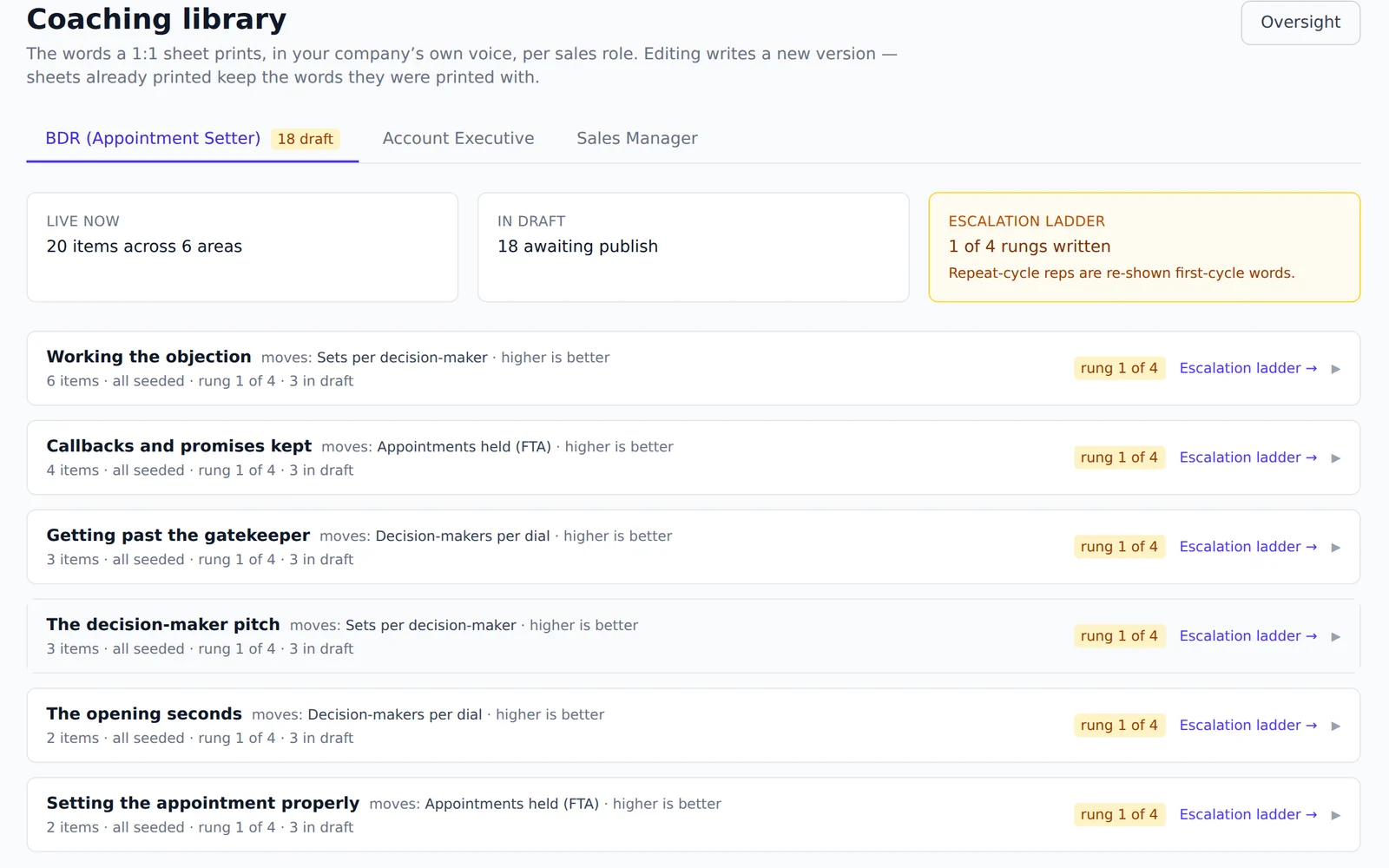
A library, and an escalation ladder.
The mechanism
Four rungs, three readers, and a rule frozen at the moment advice is given
A library of advice is easy. A library whose advice can be checked a cycle later, against the wording that was actually given, is the part that takes work.
The ladder, and the rung that refuses to invent an exercise
When the same issue recurs cycle after cycle the response escalates: written advice, then a drill, then a manager-led session, then visible to the owner. A cycle where the advice was genuinely adopted resets the chain, because a problem recurring after a real attempt is a different problem from one nobody tried.
The drill rung is the interesting one. A drill is a role-play built from your own playbook step, so a coaching area with no playbook step behind it cannot reach that rung at all — inventing an exercise against a criterion nobody wrote is fabrication with a friendly interface. Such an item skips to the manager-led rung, and the sheet prints why it skipped rather than quietly renumbering itself.
Whether advice was adopted is judged by readers that already exist
Three, and deliberately not a fourth — a fourth would be a second answer to a question something already answers, and the two would disagree on one page.
- The funnel figure the advice’s lever points at, read through the same direction rule the tiles use
- Missed playbook steps in the process ledger, deduped by the same pass the count sentence uses
- A manager-accountability occurrence count, or a scorecard sub-score
Which way counts as better is frozen when the advice is given
Some figures improve by falling — deals lost, items stuck in follow-up. The direction that counts as adoption is declared on the template and frozen onto the advice row, rather than looked up when the verdict is taken a cycle later.
That is not belt-and-braces. A verdict spans two cycles, and in between you may have edited or retired the template. A ruling has to be judged by the rule that was in force when the advice was given, or a rep gets marked against a standard that did not exist when somebody told them what to do. Advice whose target metric is real but coarse is also marked as such on the row, so an adoption verdict on one of those is known to be weaker evidence rather than assumed equivalent by a reader looking at an identical-looking column.
Editing creates a version, and your edits survive an upgrade
Every piece of advice given is logged against the exact template and version that was given. Editing a published template retires the old version rather than replacing it in place, so what a rep was told last month stays exactly as they were told it. Advice a workspace has edited is marked as theirs, and the seeder that ships new defaults will not overwrite a row carrying that mark — a product update reverting a company’s own coaching to the shipped wording is the failure that makes people stop editing anything.
Who it is for
For sales leaders with a method
If your company has a way of selling, the coaching library is where it stops living in one person’s head.
- Sales leaders codifying how their team actually sells
- Enablement teams maintaining coaching content
- Managers who want consistent advice across a team
Related
Questions
The things people actually ask.
What is the escalation ladder?
If the same issue recurs cycle after cycle, the response escalates: written advice, then a drill, then manager-led, then visible to the owner. A cycle where the advice was adopted resets the chain, because the problem recurring after a genuine attempt is a different problem.
What if there is no drill for a topic?
It skips that rung and says why, rather than inventing an exercise. The screen exists precisely because most of the ladder was unwritten, and inventing content to fill it would be worse than admitting the gap.
What if two managers edit the same template?
They join the same draft rather than creating two competing ones.
Can we start from scratch?
You start from a shipped default set and edit toward your own method. Most teams change wording long before they change structure.
What does versioning actually do to a rep’s record?
It fixes what they were told. Advice is logged against the exact template and version that was given, so when the next cycle asks whether they acted on the advice, the advice being checked is the wording they actually received. Editing a template retires the old version rather than replacing it in place, which means the escalation ladder is measuring a real repeat rather than a rep failing to follow guidance that did not exist when they were coached.
Put your method somewhere it survives.
The coaching library is the difference between a sales method and a sales manager who happens to know one.