Grounding review
The checks cost nothing, so they can run every day.
Every day a sample of yesterday’s real assistant answers is enrolled into a review queue and tested. Does every record it cited actually exist, in this tenant? Did it assert a date, a percentage or a quotation with no source behind it? Did its tools run and then produce an answer with nothing attached? These are string arithmetic and one batched existence query — no prompt, no provider, no spend. Running the audit twice costs the same as running it never.
How it works
How an answer gets checked
Three stages, and the third one is a person.
It samples what already happened
The pass reads turns that were already asked and already paid for. It never re-asks anything, which is what makes it safe to schedule — a job that quietly bills a provider every night is precisely the thing nobody notices until the invoice arrives.
It runs deterministic checks
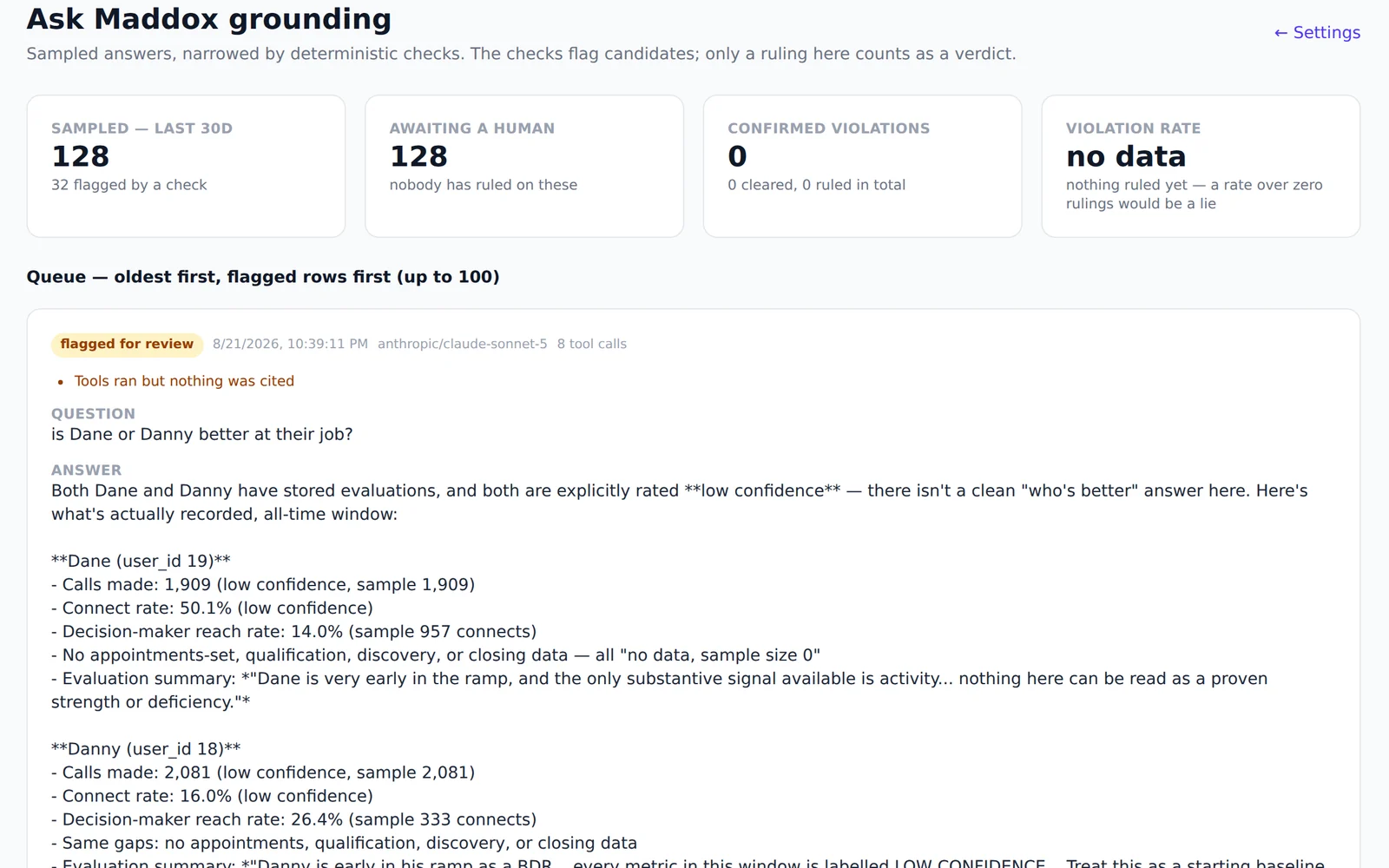
A citation is resolved against the records of that tenant and that tenant only, so a reference that would resolve against somebody else’s data reads as fabricated, which is what it is. Alongside that sit checks for unsourced specifics, malformed sources, source types that cannot be cited, and claims that something does not exist when it does.
A person rules
Every row is created open, and open is the only state the pass can produce. Cleared and violation come from a human, in the review screen, with their name and the time attached. The audit narrows the queue; it never closes it.
In the product
A queue of answers waiting on a human verdict.
Who it is for
For the person who has to trust the output
Every vendor says their assistant is grounded in your data. This is the page that says how anyone would know.
- A sales leader deciding whether an assistant’s answer can be repeated in a forecast meeting.
- A compliance owner who needs the checking to be evidenced rather than asserted.
- An administrator who wants to see the bad answers, not a confidence score.
- Anyone who has watched a chatbot invent a reference number that looked exactly right.
Related
Questions
The things people actually ask.
Does this use AI to check the AI?
No, and deliberately not. The checks are string comparisons and database lookups. A model grading another model would add cost, add a second thing that can be wrong, and produce a verdict nobody could audit.
What is a trap question?
A question with no honest answer — a company that does not exist, a metric nobody has computed, an event that has not happened yet. A grounded assistant refuses. Those are asked by a person when a person wants to know, because unlike the daily sample they do cost money to run, so they are deliberately not scheduled.
Can the system clear its own answers?
No. Every review row is created open and there is no code path from open to cleared. Refusal detection is a text match and can be fooled in both directions, so nothing is auto-cleared and nothing is auto-failed.
Does it look at other tenants’ data?
Never. The pass runs one tenant at a time precisely so a citation can be resolved inside that tenant’s own records. It is the only way a cross-tenant reference can be recognized as fabrication rather than quietly resolving.
What happens to a confirmed violation?
It is recorded against the answer, with the reason, the actor and the time. That is a record you can count and trend, which is a different thing from a dashboard that only ever shows green.
Read yesterday’s answers before you trust tomorrow’s.
The queue is the honest version of an accuracy claim.